

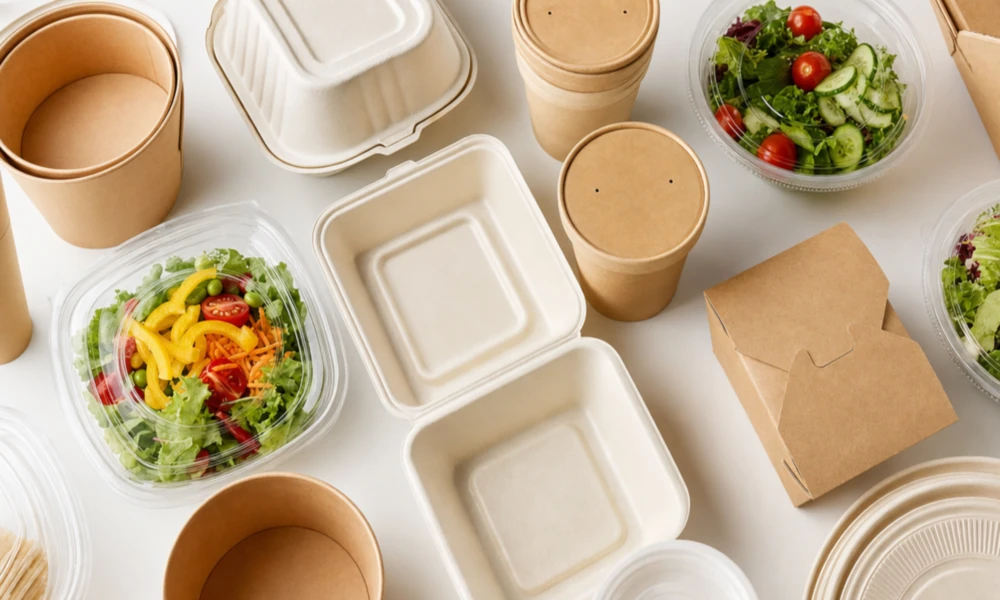
The complaint is almost never about the food. It is that the sauce escaped, the lid came off in the bag, or the fried chicken arrived soft because it steamed itself on the way over. Those are packaging failures, and they are attributed to the restaurant. Choosing food packaging boxes well means specifying against the hardest part of the journey rather than against how the container looks on a counter.
Start With the Food, Not the Box
Different foods impose different demands. Hot and wet items need heat tolerance and a genuine seal. Fried items need ventilation, because trapped steam turns crisp coating soft within minutes. Cold items need visibility and a lid that does not fog. Anything oily needs a resin that resists grease. Anything acidic needs compatibility checked. Write down which of these apply to each item on your menu, and the specification largely writes itself.
Heat Tolerance and Reheating
PP handles hot fill and reheating in a microwave, which is why it dominates hot food and meal-prep packaging. PET stays clear and rigid but deforms under heat, so it belongs with cold items. If customers will reheat in the container, that has to be stated on the packaging and the resin has to support it. Getting this wrong produces a warped container and, at worst, a customer trying to reheat something in a box that was never meant for it.
The Fried Food Problem
Crisp food packed in a sealed container arrives soft, every time, because moisture leaving the food condenses and returns to it. Ventilation solves it: perforated lids, vented corners, or a container designed with a gap that allows steam to escape while keeping the contents contained. This is the single most common packaging complaint in delivery and the easiest to fix, and it costs nothing extra to specify a vented lid for the items that need one.
Seals That Survive a Bag
Test the closure the way a rider will treat it. Lift a filled container by the lid alone. Tip it forty-five degrees and hold it. Put it in a bag with two others and carry it up a staircase. A rim that seats with an audible click around the full perimeter is doing something a lid that merely rests on top is not. Round containers seal more reliably than rectangular ones because clamping force distributes evenly, which is worth knowing for anything liquid.
Compartments and Component Separation
Where items must not touch, a divided tray does what a single box cannot: sauce away from fried items, dressing away from leaves, gravy away from anything crisp. Check whether the lid seals each compartment individually or only around the outside, since the second allows contents to cross over when a bag tips. Compartment trays cost more per unit and consume more storage space, so use them where they earn their place rather than universally.
Tamper Evidence
For delivery, a visible indication that a container has not been opened has become an expectation. Frangible tabs that break on first opening, induction seals, and tamper labels applied across the join all work, at different costs and with different implications for how fast staff can close an order during a rush. Suppliers of catering and ready-to-eat containers can usually recommend a format that needs no new equipment.
Sizing and Portion Match
An oversized box lets contents move and arrive rearranged; an undersized one overflows at the rim and stops the lid seating. Match volume to portion, and remember that a container filled to its brim will leak regardless of how good the seal is. Keeping the range to three or four sizes rather than eight simplifies storage, ordering and staff decisions during a busy service, at the cost of some containers being slightly larger than ideal.
Labelling, Branding and Legal Information
The container is also a surface that carries information, and some of it is not optional. Prepacked food sold in Singapore carries labelling obligations covering the product name, ingredients, allergens, net quantity, and date marking, so leave room for a label rather than treating the box as purely a vessel. Beyond compliance, a printed or labelled container is the only part of a delivery order that reaches the customer’s table intact, which makes it inexpensive brand exposure. Check that a curved surface will not wrinkle a flat label, and that any adhesive holds on a chilled or greasy container.
Storage, Assembly and Service Speed
Unit price is not the whole cost. Consider how much stock space each format needs, whether containers nest to reduce that, and how many seconds it takes a staff member to assemble and close each one. In a kitchen doing two hundred covers an evening, a container needing an extra five seconds costs real time. Formats that arrive assembled and stack tightly are usually worth a slightly higher unit price.
Testing Before Committing
Order samples and run them through a genuine test: fill with your actual food at actual temperature, close as staff would during a rush, put three in a delivery bag, and take them on a twenty-minute motorcycle ride. Then open them. That exercise costs an afternoon and reveals more than any specification sheet. Chosen this way, food packaging boxes stop generating complaints, which is the only measure of them that matters.
